


Cemetery Cross
or the cross of the Hospitallers
The cross of Saint Vincent has been classified as a historical monument since September 30 1911.
It is not a calvary, but what art historians have come to name a cemetery cross. It was located in the center of the old cemetery, which existed beneath the current square and was moved at the beginning of the 20th century. It dominated the entire site.
Carved crosses like this one are very rare. There are about ten throughout the national territory. It had a "sister" in the municipality of Cébazan, which was stolen, and the type of sculpture suggests that it is the work of the same artist. Most crosses of this type were much simpler, generally made of local stone, large in size with wide moldings.
This one is dated between the 15th and the very beginning of the 16th century. It was likely crafted by the knights of Saint John of Jerusalem, of which the current church was part of the Commandery, as its richness of ornamentation contrasts significantly with the geographical and economic situation of the village at that time.
worked on all four sides
To be visible from all sides:


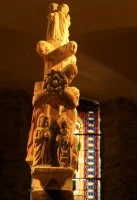
On its front face
Christ is on the cross, at the center of the main tableau. To the right, Mary Magdalene is on her knees, weeping. The artist even went as far as to carve a tear on her cheek to add more realism to the scene. Behind her stands the Virgin. She is upright, with her hands joined, in the attitude and costume generally used to represent her in burial scenes. On the left, the apostle Saint John the Baptist stands, with curly hair, raising the right side of his cloak with his left hand.
On the back face
A statue of the Virgin wearing an ornate crown. She certainly had her hands joined, but time and wear have caused them to disappear. She is surrounded by two bishops.
On the side faces
You can discover, on the right, a bishop holding an open book and a banner without inscription. This is very likely Saint Vincent, patron of the Church; on the other side, a bishop accompanied by a man with a bare torso and draped lower body, hands laden with fruits (apples and grapes), symbolizing the main agricultural production of the region.
At the top
Two statuettes of the same size, representing God the Father. His right hand is raised to bless and the other holds the globe of the world.
Restored in the spring of 2014, thanks to the partnership of the Regional Delegation for Cultural Action Languedoc Roussillon, the Regional Council of Languedoc-Roussillon, the General Council of Hérault, the network of sites and museums of Hérault, the municipality of St-Vincent d'Olargues, and with the technical support from Pays Haut Languedoc and Vignoble and the Community of Communes Orb-Jaur, it is showcased inside the church to protect it for future generations.
Visit by appointment at the town hall, located right next to the church.
Tel: 04 67 97 70 03 or Mrs. Fontés 04 67 97 78 91.


