


The History of the Priory of Saint Julien
Its Detailed History


One thousand years ago, the Lords of Olargues would have built a true fortress on the rocky spur overlooking the hamlet of Horts, in the municipality of Saint-Julien at the place known as Castellas. Dominating the entire valley and offering the guarantees of an effective and very elaborate defensive system, life there must have been quite harsh.
However, a habitat developed around this castrum. Today, an access path allows you to reach this site to visit the remains of a distant era.
Animations & Visits
The priory of Saint-Julien hosts several music festivals.
Enjoy concerts organized by the AMVJO as well as the classical music festival "Around the Quartet" in August.
To visit the Priory, contact the town hall of Saint Julien 04 67 97 70 74.

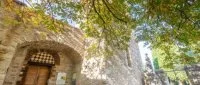
A bit of history
The church of Saint-Julien is mentioned as early as 899. Subsequently, this church will depend, with the title of Priory, on the monastic community of Cassan.
The monastery was founded in 1080. Saint-Julien was then a regular cure, which included the churches of Olargues, Berlou, and la Voulte.
In the 12th century, Pope John XXII granted the chapter of the cathedral of Saint-Pons-de-Thomières possession of various places including Saint-Julien d'Olargues and its dependencies.
During the troubles of the 16th century, the building was remodeled, a stone embedded in the facade of the bell tower dates the construction of the Tower (1585).
In the 18th century, the Sacristy was restored.
The Priory has been listed as a Historic Monument since February 12, 1951.
Architectural details
The whole of the Priory, due to its contrasted stones (pudding, volcanic rocks, gneiss and schist) gives an effect of polychromy.
Some architectural details are to be noted: The magnificent checkered tympanum, the apse decorated all around with paired Lombard arches.
The bell tower is a square tower of 6.75m on each side. Its walls are not squared. A stone bears some remains of a faded coat of arms in relief.
Inside, one of the arcades rests on a "corbel" sculpted with a woman's head covering her mouth. Could it be Eve eating an apple? Or simply an invitation to respect the silence of this holy place?


